

Words and Lyrics by Belle Jones
Composition by AJ Robertson & John Kielty
Directed by Stasi Schaeffer
Review by Dominic Corr
Once upon a time, the hunt for the ‘next big thing’ in the Scottish musical repertoire was hotly contested. There were champions, some of them brilliant, but sparse. Now, in 2026, it seems that the Scottish musical is going into overdrive. But next in the line-up is something far more special than an adaptation or revival; Flora – A New Musical, on the unsung Scottish heroine, who found themselves firmly within the history books for the abetting the Jacobite cause – but there’s far more to that here.
Every so often, a new Scottish musical arrives determined not merely to entertain but to intervene; to pick up a loose thread in the nation’s tapestry and weave it back with force. Belle Jones’s big-bold production does exactly that, striding into The Pavilion Theatre with a fire in its gut, a defiant sense of purpose, and a score that swings between traditional ceilidh‑inspired joy and modern rhythmic flourish. The result is a richly textured, rambunctious retelling of Flora MacDonald’s life: not the tidy “smuggled Bonnie Prince Charlie to Skye” myth, but the long road that followed—marked by imprisonment, famine, migration, revolution, and survivorhood.
That breadth of narrative is managed with admirable clarity through Jones’ book, which splits Flora into two presences: Flora Senior, embodied with rooted gravitas by Annie Grace, and Flora Junior, played with spirited resilience by Karen Fishwick. This structural choice is simple, elegant, and theatrically effective, granting Flora the rare opportunity to witness, interrogate, and reclaim her own story across time. The pair are marvellous in this largely ensemble piece; Fishwick is a striking force with convincing life, worthy of the many tales and history of this tremendous woman.
Director Schaeffer’s staging leans into ensemble dynamism, with the cast weaving physical storytelling through Jack Anderson’s movement direction. Scenes shift with the fluidity of memory: a cell becomes a cliff‑edge; a bustling North Carolina street folds into a quiet Skye croft. Doing much of the lifting in this larger-than-expected production, Frances Collier’s production design gives this world its distinctive contour with weather-beaten palettes, rope‑tied textures, and a stage that feels capable of carrying centuries. It’s clear, confident visual dramaturgy and rarely pulls focus unnecessarily.
Musically, composers AJ Robertson (the fantastic mind behind Mary: A Gig Theatre Show) and John Kielty craft a score steeped in Scottish traditional influence without lapsing into pastiche. Their melodies lean on harmonic warmth and fiddle‑driven rhythms, building in contemporary phrasing that keeps the material breathing. Gaelic is integrated seamlessly; never tokenistic, always purposeful. In ensemble numbers, actor‑musicianship is foregrounded: fiddles, whistles, percussion, and voices collide in scenes that feel alive, messy, communal. This is where the show is at its most joyful, its most electric and truly captures the sense of the nation’s musical heritage without dragging out the shortbread tin.
Fishwick’s Flora Junior is a standout: stubborn, funny, furious, and often the grounding force in a world intent on sweeping her along. Her vocal work threads steel through vulnerability, particularly in sequences tracking her displacement across the Atlantic. Grace, meanwhile, delivers Flora Senior as a weathered yet unbowed narrator – less ghost than guardian- with a presence much of the emotional hinge for which the show pivots. Their eventual duet – simple, clean, intimately scored – becomes a quiet triumph, the musical’s emotional apex.
Around them, the ensemble excels in multiple roles with sharp comic touch. Alan McHugh, Sally Swanson, Lana Pheutan, David Rankine, Stephen Clyde and Lawrence Boothman conjure soldiers, statesmen, husbands, rebels, and fools with just the right amount of theatrical cheek. A crème-de-la-creme of some of Scotland’s notable performers; Boothman catapults themselves to the forefront with a camp, yet driven, near secondary lead as Charles Stuart; similar to Rankine’s key role as the Irish Jacobite Felix O’Neill in a jaunty role.
Yet while the storytelling flows with bold momentum, the production is not without bruises. Sound mixing—particularly in larger ensemble scenes—occasionally muddies lyrical detail (which gains enormous praise for the fluid lacing of Gaelic and spoken English), burying internal rhymes and narrative clarity beneath instrumentation. The collision of actor‑musicianship and vigorous movement occasionally overwhelms, with wording lost in the swirl; yet equally carried over by traditional Scottish tones from the tin whistle or strings.
Vibrant and a fiercely crafted piece of historical reclamation; Flora – A New Musical lands with confidence. It pushes back against the narrow framing of Flora MacDonald as a footnote in a prince’s legend, instead unearthing a life shaped by forces much larger than romance or rebellion. The production revels in humour, leans into hardship, and ultimately treats its heroine with the complexity history denied her. This is ambitious Scottish theatre – lyrical and defiantly communal. And more so, in a quagmire where audiences cannot turn without landing on a stray lyric or a jutting tune, Flora is a jubilation, and a new musical that already feels like it has carved space for itself in the nation’s contemporary stage story.
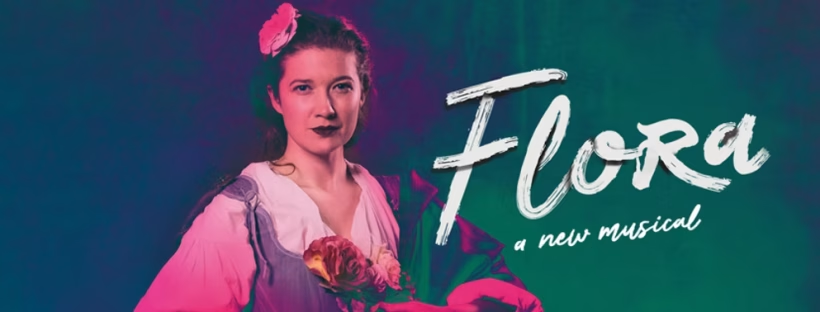
A Jubilation; Vibrant and Fierce
Flora – A New Musical runs at The Pavilion Theatre, Glasgow, until March 28th
Running time: Two hours and twenty minutes with one interval
Photo credit: Ewan Wetherspoon
Review by Dominic Corr (contact@corrblimey.uk)
Editor for Corr Blimey, and a freelance critic for Scottish publications, Dominic has been writing freelance for several established and respected publications such as BBC Radio Scotland, The List, The Scotsman, Edinburgh Festival Magazine, The Reviews Hub, In Their Own League, The Wee Review and Edinburgh Guide. As of 2023, he is a member of the Critic’s Award for Theatre Scotland (CATS) and a member of the UK Film Critics.
